
Loading...
Tooba Asad • 21 Nov 2026
Sustainable printing is becoming an important consideration for companies that want to maintain professional branding while reducing their environmental impact. Businesses are increasingly exploring eco-friendly paper, responsible ink choices, recyclable materials, and efficient production methods to make their printed marketing materials more environmentally responsible.
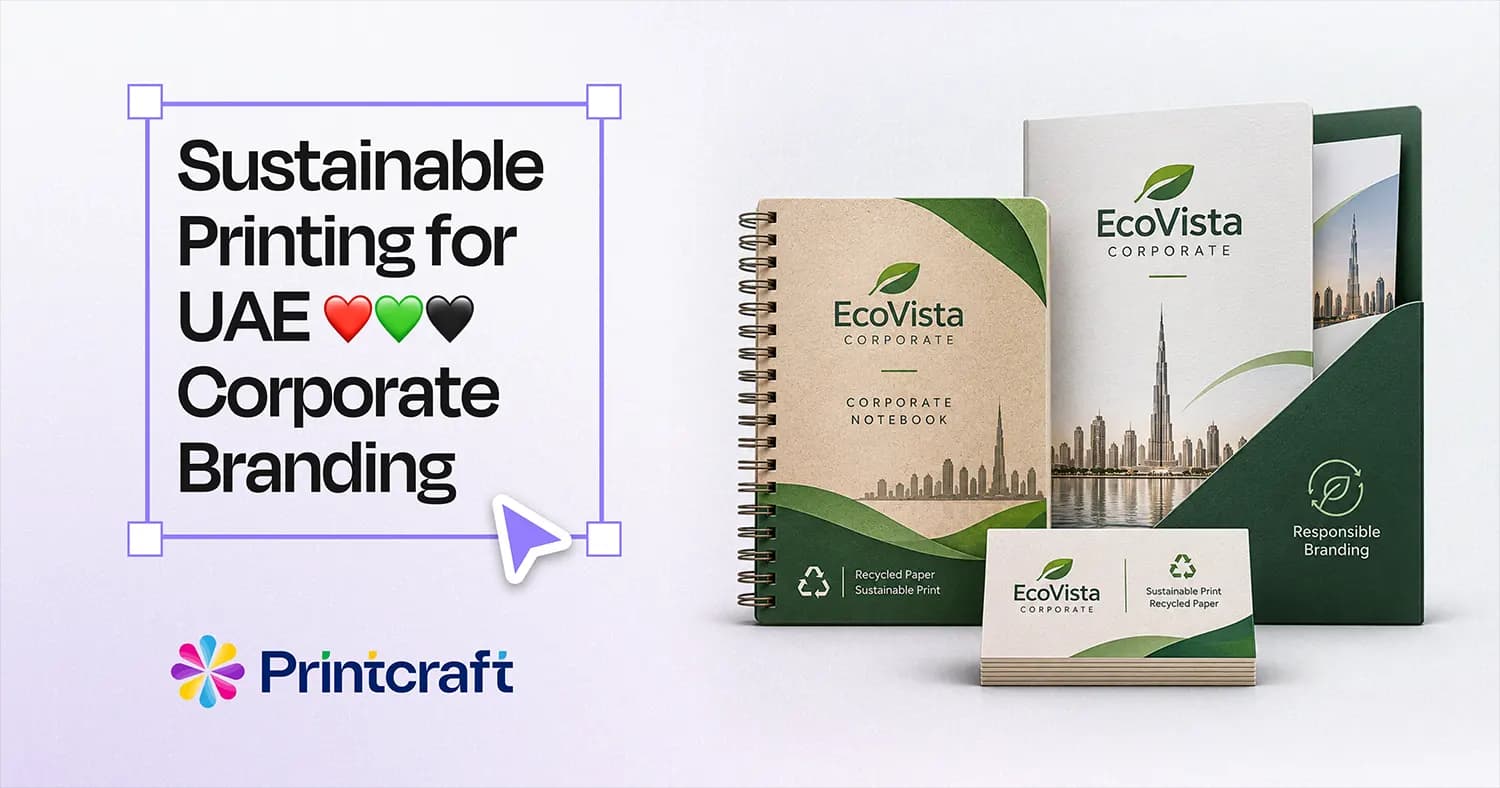
Corporate branding is an important part of building a successful business. From business cards and brochures to product packaging, catalogues, and promotional materials, printed products help companies communicate their identity and create lasting impressions. However, as businesses across the UAE become more conscious of environmental responsibility, traditional printing practices are gradually evolving.
Sustainable printing is becoming an important consideration for companies that want to maintain professional branding while reducing their environmental impact. Businesses are increasingly exploring eco-friendly paper, responsible ink choices, recyclable materials, and efficient production methods to make their printed marketing materials more environmentally responsible.
In a competitive market like the UAE, adopting sustainable printing practices can also help businesses demonstrate their commitment to responsible operations. Customers, employees, and business partners are paying greater attention to how companies manage their resources and environmental responsibilities.
Whether you operate a corporate office, retail business, hospitality company, or growing startup, sustainable printing offers opportunities to improve your branding while supporting more responsible business practices.
In this blog, we will explore why sustainable printing is becoming a new standard for UAE corporate branding, its benefits, popular eco-friendly printing options, and how businesses can make more responsible printing decisions.
Sustainable printing refers to printing practices that aim to minimize environmental impact throughout the production process. It involves selecting environmentally responsible materials, reducing waste, improving resource efficiency, and using production methods that support better environmental outcomes.
Unlike conventional printing, which may rely heavily on virgin paper, resource-intensive production, and non-recyclable materials, sustainable printing focuses on making more responsible choices without compromising the quality of printed products.
Some common sustainable printing practices include:
These practices allow businesses to maintain professional printed branding while considering the environmental impact of their printing requirements.
The UAE has been increasing its focus on sustainability, responsible resource management, and environmental initiatives. As a result, businesses are exploring practical ways to align their operations with sustainability goals.
Corporate branding is one area where companies can make meaningful improvements. Printed marketing materials are used across almost every industry, including real estate, hospitality, retail, healthcare, education, and financial services.
Choosing sustainable printing options allows businesses to make more responsible decisions while maintaining a consistent brand image.
Several factors are contributing to the growing importance of sustainable printing in the UAE.
Growing Environmental Awareness: Customers and business partners are becoming more conscious of environmental issues. Businesses that demonstrate responsible practices can communicate stronger environmental awareness.
Corporate Sustainability Goals: Many organizations are introducing sustainability policies and looking for ways to incorporate environmentally responsible materials into their everyday operations.
Responsible Brand Positioning: Sustainable printing allows businesses to communicate their commitment to reducing waste and making better material choices.
Changing Customer Expectations: Customers increasingly appreciate businesses that consider environmental impact when developing products, packaging, and marketing materials.
Long-Term Business Value: Efficient material usage and reduced printing waste can help businesses manage resources more effectively.
Sustainable printing is therefore becoming more than a design preference. It is an important consideration for companies looking to build responsible and future-focused brands.
Sustainable printing offers several advantages beyond environmental responsibility. It can also influence how customers perceive a business and how effectively companies manage their branding materials.
A company's branding communicates its values, priorities, and professional identity. When businesses use recycled paper, responsibly sourced materials, and environmentally considerate printing options, they demonstrate that sustainability is part of their business approach.
For example, a company distributing brochures printed on recycled paper can communicate its environmental commitment through an everyday marketing material.
Similarly, businesses using recyclable packaging and sustainable promotional products can create a more consistent brand message.
This approach can help companies develop a positive reputation among customers, suppliers, and business partners who value responsible business practices.
Traditional printing can involve significant material consumption, energy usage, and production waste. Sustainable printing aims to reduce these impacts through more efficient processes and responsible material selection.
Using recycled paper can reduce the demand for virgin paper resources, while efficient production planning helps minimize unused materials.
Businesses can also consider recyclable packaging and suitable low-impact inks to make their printed materials more environmentally responsible.
Although no printing method is completely impact-free, choosing better materials and reducing unnecessary waste can make a meaningful difference.
Sustainable printing does not mean compromising on professional appearance or design quality.
Modern printing technologies allow businesses to produce attractive marketing materials using various recycled papers, responsibly sourced stocks, and environmentally considerate inks.
Companies can maintain consistent colors, typography, logos, and design elements across their business cards, brochures, folders, catalogues, and other printed materials.
This ensures that sustainability becomes part of the company's visual identity rather than a separate marketing activity.
Customers often notice the materials and packaging used by businesses. Sustainable printed products can create opportunities to communicate environmental values directly.
For instance, companies can include short sustainability messages on packaging, brochures, or product labels to explain their material choices.
These small details can help customers understand the company's approach to responsible branding.
However, businesses should ensure that all environmental claims are accurate and supported by the materials or certifications used.
Sustainable printing encourages businesses to evaluate how much material they actually need.
Instead of printing excessive quantities of brochures, flyers, or catalogues, companies can plan production according to their marketing campaigns and distribution requirements.
This helps reduce unused inventory, unnecessary paper consumption, and storage requirements.
Businesses can also consider digital alternatives for frequently updated information while reserving printed materials for situations where physical communication adds value.
Selecting appropriate materials is one of the most important steps in sustainable printing. Different businesses have different requirements depending on their branding style, product type, and intended application.
Here are some popular options used in environmentally conscious printing.
Recycled paper is manufactured using recovered paper fibers instead of relying entirely on newly sourced raw materials.
It is commonly used for brochures, business cards, flyers, stationery, and office documents.
Businesses can choose from different recycled paper grades depending on the required thickness, texture, and printing quality.
Recycled paper is a practical option for companies that want to reduce their reliance on virgin paper while maintaining professional printed materials.
Paper carrying Forest Stewardship Council (FSC) certification comes from forests and supply chains managed according to recognised environmental and social standards.
Businesses can consider FSC-certified paper when they want greater assurance about the sourcing of their printed materials.
It is suitable for corporate brochures, catalogues, business stationery, reports, and other professional printing requirements.
Choosing certified paper can also help businesses communicate responsible sourcing practices more transparently.
Kraft paper is recognized for its natural brown appearance and strong texture. It is commonly used in packaging, shopping bags, product labels, and promotional materials.
Its natural appearance makes it particularly suitable for brands that want to communicate simplicity and an environmentally conscious identity.
Kraft paper can be used for various corporate branding applications, including customized packaging and printed promotional materials.
However, businesses should check whether the specific kraft paper product is recycled, responsibly sourced, or otherwise certified before making environmental claims.
Vegetable-based inks use vegetable oils, such as soy or other plant-derived oils, as part of their formulation.
Depending on the formulation, they can offer an alternative to some conventional petroleum-based inks.
These inks can support high-quality printing for brochures, magazines, business stationery, and marketing materials.
Businesses should discuss ink specifications with their printing provider to understand their suitability for particular printing applications.
Packaging is an important part of corporate branding, particularly for retail, hospitality, food, and e-commerce businesses.
Companies can consider recyclable paperboard, cardboard, and other suitable packaging materials to reduce reliance on unnecessary plastic components.
Custom printed cartons, paper bags, product boxes, and branded packaging can be designed to maintain a professional appearance while considering end-of-life recyclability.
It is important to remember that recyclability depends on the material composition, coatings, adhesives, and local recycling facilities.
Sustainable printing is relevant to businesses across different sectors. Each industry uses printed materials differently, which means the most suitable solutions depend on specific operational and branding requirements.
Corporate offices regularly require business cards, letterheads, presentation folders, company profiles, reports, and other stationery.
Switching to recycled or responsibly sourced paper can help these businesses incorporate sustainability into everyday corporate communication.
Professional printing finishes and consistent branding can ensure that their materials continue to look polished and credible.
Retailers use shopping bags, product labels, packaging boxes, promotional flyers, and product information cards.
Sustainable paper packaging and recyclable materials can help these businesses make more responsible packaging choices.
E-commerce companies can also review packaging dimensions and reduce unnecessary materials to improve resource efficiency.
Restaurants, hotels, cafés, and catering companies use menus, takeaway packaging, food labels, promotional materials, and branded paper bags.
They can consider recyclable packaging, suitable food-contact materials, and responsibly sourced paper for different applications.
For food-related printing, businesses should always ensure that materials comply with the relevant food-contact requirements.
The UAE real estate and construction industries use brochures, property catalogues, presentation folders, marketing booklets, and project documentation.
Sustainable printing can help these businesses align their promotional materials with broader environmental commitments.
Recycled paper and responsibly sourced printing materials can be particularly useful for large marketing campaigns and corporate presentations.
Schools, colleges, training centres, and educational organisations frequently print brochures, prospectuses, certificates, event materials, and learning resources.
Using recycled paper and optimising printing quantities can help educational institutions reduce unnecessary material consumption.
As sustainability becomes more important in business operations, printing and branding practices are also evolving.
Several trends are influencing how companies approach their printed marketing materials.
Minimalist Printing Designs: Businesses are increasingly considering clean layouts, simple graphics, and efficient material usage. Minimalist designs can reduce unnecessary visual elements and support a sophisticated brand identity.
Recycled and Certified Materials: More businesses are exploring recycled paper and responsibly sourced materials for their corporate stationery and packaging.
Eco-Conscious Packaging: Companies are considering recyclable cartons, paper bags, and other packaging alternatives that align with their product and distribution requirements.
Smaller and More Targeted Print Runs: Rather than producing excessive quantities, businesses can print according to actual demand and update their materials when necessary.
Combination of Digital and Printed Marketing: Companies are using digital communication for frequently changing information while maintaining printed brochures, catalogues, and business stationery for important customer interactions.
Sustainable Corporate Events: Businesses organising exhibitions, conferences, and promotional events can consider recycled promotional materials, reusable displays, and responsible printed event stationery.
These trends show that sustainable printing is becoming an important part of modern corporate branding strategies.
Selecting sustainable printing options requires careful planning. Not every eco-friendly material is suitable for every application, and businesses should consider both performance and environmental impact before making a decision.
Here are some important factors to evaluate.
Start by identifying the printed products your business uses regularly.
These may include business cards, brochures, flyers, product labels, company profiles, folders, shopping bags, and packaging boxes.
Understanding your requirements makes it easier to identify where sustainable materials can be introduced.
Different printing applications require different material specifications.
For example, business cards may require thicker paper, while brochures may need lighter stocks for easy distribution.
Choose recycled, certified, or responsibly sourced materials that meet the functional and visual requirements of each product.
Printing finishes can affect the recyclability and overall environmental impact of a printed product.
Some laminations, coatings, adhesives, and embellishments can make paper-based products more difficult to recycle.
Discuss available options with your printing provider and select finishes that balance appearance, durability, and environmental considerations.
One of the easiest ways to reduce printing waste is to avoid producing unnecessary quantities.
Review your expected requirements before placing an order. If your business regularly updates contact details, product information, or promotional offers, smaller print runs may help prevent outdated materials from going unused.
An experienced printing provider can help you understand different paper grades, ink options, printing techniques, and finishing requirements.
They can also recommend suitable alternatives based on your budget, branding objectives, and sustainability preferences.
Although sustainable printing offers several advantages, businesses should avoid making decisions based only on marketing claims or material labels.
Here are some common mistakes to consider.
Assuming Every Recycled Material Is the Same: Recycled paper is available in different grades and compositions. Always review the material specifications before choosing an option.
Ignoring Product Requirements: A material that works for brochures may not be suitable for product packaging exposed to moisture or heavy handling.
Using Unsupported Environmental Claims: Avoid describing products as fully biodegradable, recyclable, or environmentally friendly unless the relevant claims can be verified.
Overlooking Finishing Materials: Certain coatings, laminations, and decorative elements may affect recyclability. Review the complete construction of the printed product.
Ordering Excessive Quantities: Printing more materials than necessary can create avoidable waste, even when sustainable paper is used.
Focusing Only on Price: The cheapest option may not provide the right balance of quality, durability, and environmental performance.
Making informed decisions helps businesses develop a sustainable printing approach that supports both their branding and operational needs.
Sustainable printing is expected to remain an important consideration as businesses across the UAE continue to evaluate their environmental responsibilities.
Companies are increasingly looking beyond the visual appeal of their marketing materials and considering how those materials are sourced, produced, used, and disposed of.
Advancements in printing technology, recycled materials, efficient production methods, and environmentally considerate inks are creating more opportunities for businesses to make responsible choices.
Corporate branding is also evolving. Customers expect businesses to communicate their values through their actions, not just through advertising messages.
As a result, sustainable printing can become a valuable part of a company's broader branding strategy. Businesses that make thoughtful material choices and reduce unnecessary printing waste can build a more consistent and responsible brand identity.
Sustainable printing is becoming an important part of modern corporate branding in the UAE. From recycled paper business cards and professionally printed brochures to customised packaging and corporate stationery, businesses have several opportunities to make more responsible printing choices.
At Printcraft, we understand that high-quality printing is essential for creating a strong and consistent brand identity. We provide customised printing and packaging solutions to help businesses present their brands professionally.
Whether you need business cards, brochures, company profiles, presentation folders, flyers, or customised packaging, choosing suitable materials and printing specifications can help you achieve the right balance between quality and responsible production.
If your business is planning to improve its corporate branding with more sustainable printing choices, get in touch with Printcraft today.
Contact Printcraft:
Let's create professional printed materials that reflect your brand identity and support more responsible business practices.
1. What is sustainable printing?
Sustainable printing refers to printing practices that aim to reduce environmental impact through responsible material selection, efficient production methods, reduced waste, and the use of recyclable or recycled materials where suitable.
2. Why is sustainable printing important for UAE businesses?
Sustainable printing helps UAE businesses make more responsible branding decisions, reduce unnecessary material waste, and demonstrate their commitment to environmental responsibility. It can also support their wider corporate sustainability goals.
3. What materials are used in sustainable printing?
Common materials include recycled paper, FSC-certified paper, kraft paper, recyclable paperboard, and other responsibly sourced printing materials. The most suitable option depends on the intended application.
4. Is recycled paper suitable for professional corporate branding?
Yes. Recycled paper is available in different thicknesses, textures, and finishes, making it suitable for business cards, brochures, letterheads, company profiles, and other corporate printing requirements.
5. What are the benefits of vegetable-based printing inks?
Vegetable-based inks use plant-derived oils as part of their formulation and can provide an alternative to some petroleum-based inks. Depending on the formulation, they may offer environmental advantages while maintaining good printing quality.
6. Can sustainable printing reduce business costs?
Sustainable printing can help businesses manage costs through efficient production planning, reduced paper waste, and appropriate material selection. However, some environmentally certified materials may cost more than conventional alternatives.
7. Which corporate printing products can be made using sustainable materials?
Businesses can use sustainable materials for business cards, brochures, flyers, letterheads, presentation folders, company profiles, catalogues, paper bags, and various packaging products.
8. Is kraft paper considered an eco-friendly printing material?
Kraft paper can be a suitable option for environmentally conscious packaging, particularly when it is recycled or responsibly sourced. However, its environmental impact also depends on manufacturing processes, coatings, and disposal methods.