
Loading...
Loading...
Tooba Asad • 20 Sep 2026
Learn how to choose the right roll-up banner size, material, finish, and design for exhibitions, events, retail displays, and business promotions. Discover practical tips for creating a professional banner that gets noticed.
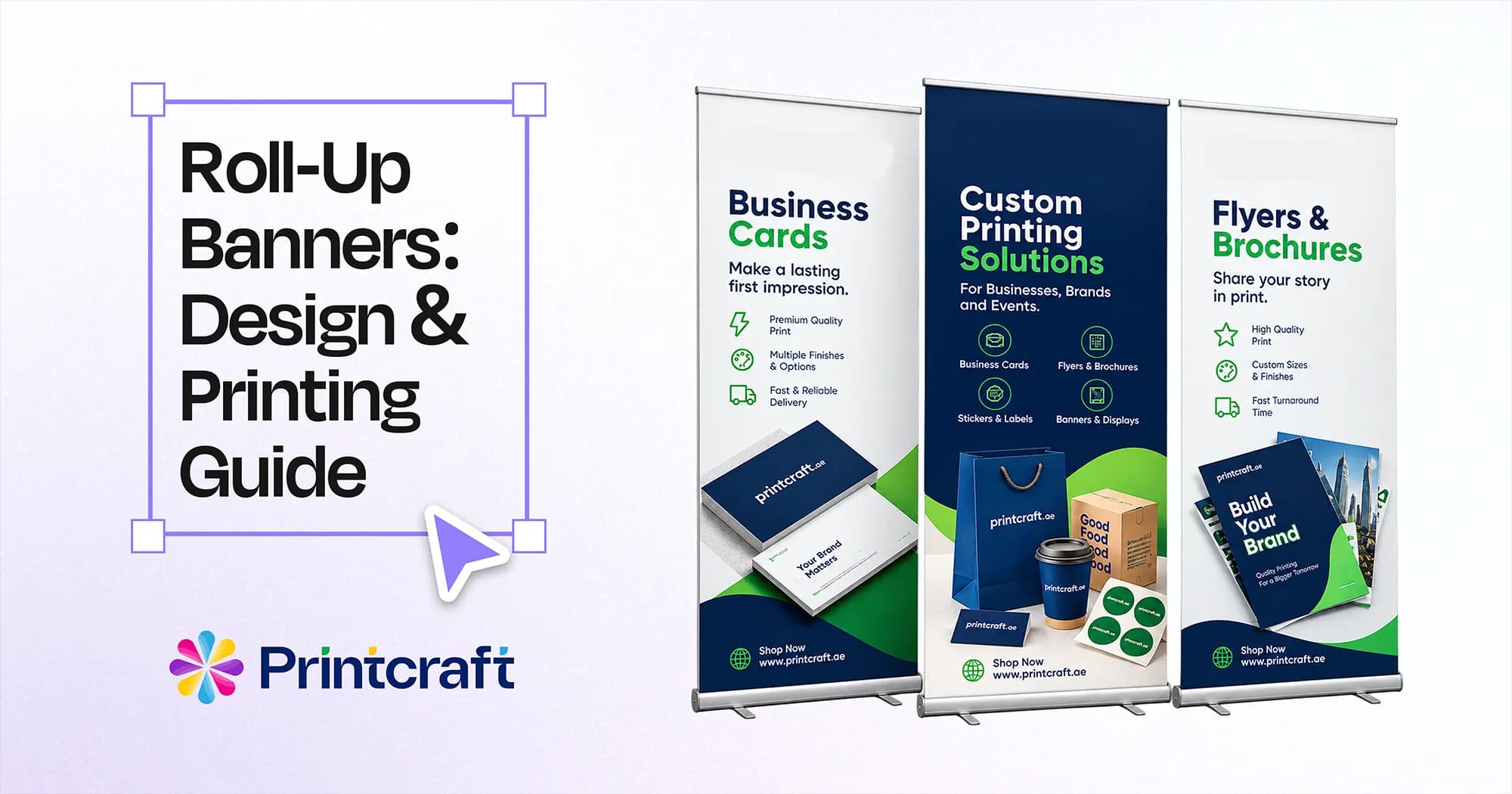
When businesses need a professional display that can be transported easily, set up quickly and reused at different locations, roll up banner printing is one of the most practical display solutions available.
A well-designed roll-up banner can introduce a brand at an exhibition, highlight a product at a launch, promote an offer inside a retail store or provide clear branding at a conference. Its effectiveness, however, depends on much more than simply printing a logo on a large sheet.
The size, material, retractable stand, artwork, typography, image quality and placement of information all influence how the final banner looks and how effectively people can read it.
For businesses preparing for an exhibition, corporate event, retail promotion or marketing campaign, understanding these details before ordering can help avoid common printing and design mistakes.
A roll-up banner, also called a retractable banner or pull-up banner, consists of a printed graphic attached to a spring-loaded base.
The printed panel rolls into the base for storage and can be pulled upward when the banner needs to be displayed. A support pole holds the graphic in its upright position.
This design gives the banner several practical advantages:
Unlike a fixed sign, a roll-up banner can be packed away after an event and transported to the next location.
That makes it particularly useful for businesses that attend multiple events or regularly change their promotional displays.
The biggest strength of a roll-up banner is its combination of visibility and portability.
Businesses can take the same branded display from an office reception to a conference, exhibition, product launch or retail activation.
Current UAE printing providers commonly position roll-up banners for exhibitions, conferences, receptions, retail promotions, showrooms and corporate events.
The banner retracts into its base, making it considerably easier to transport than many large-format fixed displays.
A carry bag can further simplify transportation between events.
A typical retractable system does not require complicated installation. The base is placed on the floor, the support pole is assembled and the graphic is pulled upward.
This is especially useful when event teams have limited setup time.
Unlike temporary posters that may need to be replaced after each campaign, a roll-up banner can be stored and reused when the message remains relevant.
A large vertical display provides enough space for a business logo, headline, product image, key message and call to action without requiring a permanent installation.
One reason custom roll up banners remain popular is their versatility.
Exhibitions are one of the most common applications.
A roll-up banner can be positioned at the entrance of a booth, beside a product display or near a meeting area.
For exhibition environments, the banner should communicate the business message quickly because visitors may only glance at it while walking through the venue.
Businesses can use roll-up banners for:
The design can include the company logo, event name, sponsors or a specific campaign message.
Retail businesses can use roll-up displays near:
This makes it possible to promote a limited-time offer without permanently changing the store's signage.
A branded roll-up banner can be placed near a reception desk to introduce a company, service, campaign or upcoming event.
Because the display does not require wall installation, it can be moved when the layout changes.
Hotels, restaurants and event venues can use retractable banners to direct guests or promote:
Schools, colleges, training centres and universities can use roll-up banners for open days, admissions, seminars and promotional events.
A roll-up banner can provide a dedicated visual area for a newly launched product.
A strong product image, short headline and clear call to action can communicate the essential message without requiring a large exhibition wall.
Size is one of the first decisions you need to make.
There is no universal size that is perfect for every application. The right width depends on viewing distance, available floor space, number of banners and amount of content.
Common roll-up widths in the UAE market include approximately 85 cm, 100 cm and wider formats, while height is commonly around 200 cm. Larger formats are also available for applications requiring greater visual coverage.
An approximately 85 × 200 cm banner is a popular choice for:
Its relatively narrow footprint makes it convenient where floor space is limited.
It can also work well when several banners need to be positioned together.
A 100 × 200 cm format provides additional width for:
This can be useful when the banner needs stronger visual presence without moving into a very large display format.
Wider formats can be useful for larger venues, stage areas, product launches or displays where the banner needs to compete with a larger visual environment.
The important point is not to select a larger banner simply because it is available.
Choose the size based on the space and viewing distance.
Material affects the banner's appearance, print quality, durability and performance under different lighting conditions.
Common materials include PVC/synthetic media and fabric-based materials. PVC and synthetic media are widely used for standard roll-up displays, while fabric can provide a softer, more premium appearance with reduced glare.
This is a practical option for many standard indoor applications.
It can provide:
It is commonly used for exhibitions, retail displays and corporate events.
Fabric can provide a softer visual appearance and reduced reflection under strong exhibition lighting.
It may be worth considering when the display is intended to have a more premium appearance or when glare could affect readability.
Finish can also affect how the banner looks.
A matte finish can reduce reflections and make text easier to read in brightly lit environments.
A gloss finish can create stronger visual vibrancy and a more polished appearance, particularly for colorful graphics and photographic designs.
For exhibition halls with intense lighting, glare should be considered before selecting the finish.
A high-quality print cannot rescue a poorly designed banner. This is where many businesses make mistakes.
They try to place their entire company profile, list of services, contact information and multiple offers onto one vertical display.
The result is usually too much information and too little visual hierarchy. A roll-up banner should communicate its main message quickly.
Recent banner-design guidance consistently emphasizes keeping the headline and primary branding in the upper and middle portions while avoiding excessive content in the lower section, where visibility can be affected by the stand or nearby furniture.
A strong banner can be divided into three broad areas.
Place the:
This establishes immediately who the banner belongs to.
This is the most valuable visual area.
Use it for:
The lower section can contain:
The exact layout can vary, but the most important information should not be pushed into the bottom section.
A banner is not a brochure.
People usually see it while standing or walking, often from several metres away. If they need to stop and read several paragraphs, the design is not doing its job.
Instead of:
“We are a leading company providing comprehensive and innovative solutions…”
Consider something much more direct:
Grow. Simplify. Scale.
Then use a short supporting line and one clear call to action.
The objective is to make the message understandable at a glance.
Your font choice affects readability.
Avoid:
Instead, use a strong headline font and a simple supporting font.
Your audience should be able to understand the main message without standing directly against the banner.
Your brand colors should remain recognizable, but branding should not come at the expense of readability.
For example, light grey text on a white background may look attractive on a computer screen but become difficult to read when printed and viewed from several metres away.
Before finalizing the artwork, check:
Background → Text → Contrast → Readability
If these four elements work together, the banner is much more likely to communicate effectively.
Images are often the most noticeable element on a roll-up banner.
Low-resolution photographs can appear blurry or pixelated when enlarged.
For professional printing, use high-quality images and vector logos whenever possible.
If your banner contains product photography, make sure the original image has enough resolution for the final display dimensions.
The bottom part of a roll-up banner is often the least effective location for your most important information.
The banner stand occupies the base, while tables, counters and people can also block the lower portion of the design.
For this reason, place your:
Logo + main headline + primary visual
higher on the banner.
Keep secondary details lower down.
This is especially important for exhibition booths where people may be standing around the banner.
A QR code can be useful when it has a clear purpose.
Instead of simply adding a QR code because there is empty space, connect it to something valuable, such as:
Add a short instruction next to it, such as:
Scan to Explore
or
Scan for Our Full Catalogue
This tells the viewer what will happen after scanning.
Exhibition environments are different from offices or shops.
There may be:
Your banner therefore needs to work from a distance.
One current Dubai printing guide recommends thinking about readability from several metres away and selecting wider formats when the banner needs to compete across a larger exhibition space.
For exhibitions, focus on:
One strong message + one strong image + clear branding + one CTA.
That is usually more effective than attempting to communicate everything about the business.
The answer depends on the size and layout of the space.
A better approach is to create a visual system.
Banner 1: Brand introduction
Banner 2: Products/services
Banner 3: Key benefits or campaign
All three should use the same:
A banner should communicate, not overwhelm.
If the headline is difficult to find, the viewer may not understand the purpose of the banner.
Pixelated images can make an otherwise professional design look low-quality.
Beautiful colors are not useful if the text cannot be read.
Keep critical information away from areas that may be blocked.
Choose one primary action rather than asking visitors to call, email, visit five pages and follow three social accounts.
Remember that the graphic becomes part of a physical display system. The bottom of the artwork interacts with the cassette and surrounding floor space.
A design that looks excellent at 100% zoom may not work when printed at full height and viewed from several metres away.
Always assess the design at realistic viewing distances.
Before sending the design to print, check:
Create the artwork according to the final banner size and the printer's specifications.
Use high-resolution images and vector artwork wherever possible.
Prepare artwork according to the printer's required color profile.
Follow the printer's required bleed and safe-area specifications.
Convert fonts to outlines where appropriate or ensure the required fonts are properly embedded.
Keep logos, text and important information away from areas that may be affected by trimming or the banner mechanism.
Review the artwork at full size before approving production.
A quality roll-up banner can be reused, but proper handling matters.
When removing the banner:
The retractable mechanism is an important part of the display, so careless handling can damage it.
Price should not be the only factor when comparing printing providers.
Before ordering, ask about:
Check whether the provider produces sharp text and accurate colors.
Ask what media is being used and whether it suits your intended application.
The printed graphic is only one part of the product. The base and support mechanism also affect usability.
Make sure the provider can produce the size required for your space.
If your artwork is not ready, check whether professional design assistance is available.
A digital proof before production can help catch errors before the banner is printed.
For exhibitions and events, confirm the production and delivery schedule before placing the order.
A proper carrying bag makes transportation and storage much easier.
For businesses participating in exhibitions, conferences, retail activations and corporate events, roll up banner printing in Dubai provides a practical way to create a professional physical presence without installing permanent signage.
Dubai's exhibition and event environment also means banners may be viewed under strong venue lighting and from relatively long distances, making material, contrast, size and typography particularly important considerations. UAE printing providers commonly offer standard 85 × 200 cm and wider formats, alongside different media and finish options.
Whether you need one banner for a reception area or multiple displays for an exhibition booth, the design should be built around the environment in which the banner will actually be used.
Before you approve your banner, ask yourself:
✓ Is the logo immediately visible?
✓ Can someone understand the main message within a few seconds?
✓ Is the headline large enough?
✓ Is the text easy to read from several metres away?
✓ Is the main image high resolution?
✓ Is there enough contrast between text and background?
✓ Is the bottom section free of critical information?
✓ Is the QR code large enough to scan?
✓ Does the design match your brand?
✓ Is the chosen size appropriate for the space?
✓ Is the material suitable for the venue?
✓ Have you checked the final artwork at full size?
If the answer is yes to these questions, your artwork is much more likely to work as a physical display rather than simply looking good on a computer screen.
A successful roll up banner is not simply a large printed advertisement.
It is a carefully designed visual communication tool that has to work within a physical environment.
The right combination of size, material, print quality, typography, imagery, layout and branding can turn a simple retractable display into an effective business asset.
For exhibitions, conferences, retail promotions, receptions and corporate events, the biggest advantage is the ability to create a professional display that is easy to transport, quick to set up and practical to reuse.
If you are planning roll up banner printing in Dubai, start by defining the purpose of the banner, measuring the available space, selecting the appropriate size and material, and creating a design that communicates one clear message.
Need a professional roll-up banner for your next event, exhibition or business promotion? Choose a print-ready design that puts your brand, message and call to action where customers can see them clearly.
1. What is a roll-up banner?
A roll-up banner is a retractable display consisting of a printed graphic and a base mechanism that rolls the graphic into the stand for storage and transportation.
2. What is the standard roll-up banner size?
Around 85 × 200 cm is one of the most commonly used standard formats, although 100 cm and wider options are also widely available. The right size depends on the available space and viewing distance.
3. What are roll-up banners used for?
They are commonly used for exhibitions, trade shows, conferences, retail promotions, corporate events, reception areas, product launches and promotional campaigns.
4. Are roll-up banners reusable?
Yes. A retractable banner can be rolled into its base, stored and transported for future use. Proper handling and storage can help protect the printed graphic and mechanism.
5. What material is best for a roll-up banner?
The appropriate material depends on the application. PVC or synthetic media can be practical for standard displays, while fabric can provide a softer appearance and reduced glare.
6. Should a roll-up banner be matte or glossy?
Matte can be preferable where glare reduction and readability are priorities, while gloss can provide stronger visual vibrancy. Consider the venue's lighting before choosing the finish.
7. What should I put on a roll-up banner?
Include your logo, one strong headline, a key visual or message, limited supporting information and one clear call to action. Avoid turning the banner into a full brochure.
8. Can I put a QR code on a roll-up banner?
Yes. A QR code can direct visitors to a website, digital catalogue, WhatsApp, registration page, online offer or other relevant destination.
9. Are roll-up banners good for exhibitions?
Yes. Their portability, quick setup and vertical format make them practical for exhibition booths and trade shows. The design should prioritize readability because visitors may view the banner while walking past.
10. How do I choose the right roll-up banner size?
Consider your available floor space, viewing distance, amount of content, number of banners and venue. A standard-width banner can work well for compact areas, while wider formats can provide more visual presence in larger spaces.
At printcraft.ae, we provide professional roll-up banner printing in Dubai for exhibitions, conferences, retail promotions, corporate events, and business displays. Choose the right size, material, and finish for your project and get a professionally printed banner ready for your next event.
Get a Quote / Browse Roll-Up Banners / hello@printcraft.ae / +971556265479