
Loading...
Loading...
Tooba Asad • 26 Oct 2026
Businesses need clear records of money received, payments made, goods delivered, and services provided. Whether you operate a retail shop, trading company, restaurant, maintenance business, or wholesale operation, keeping these transactions organized is essential for everyday business management.
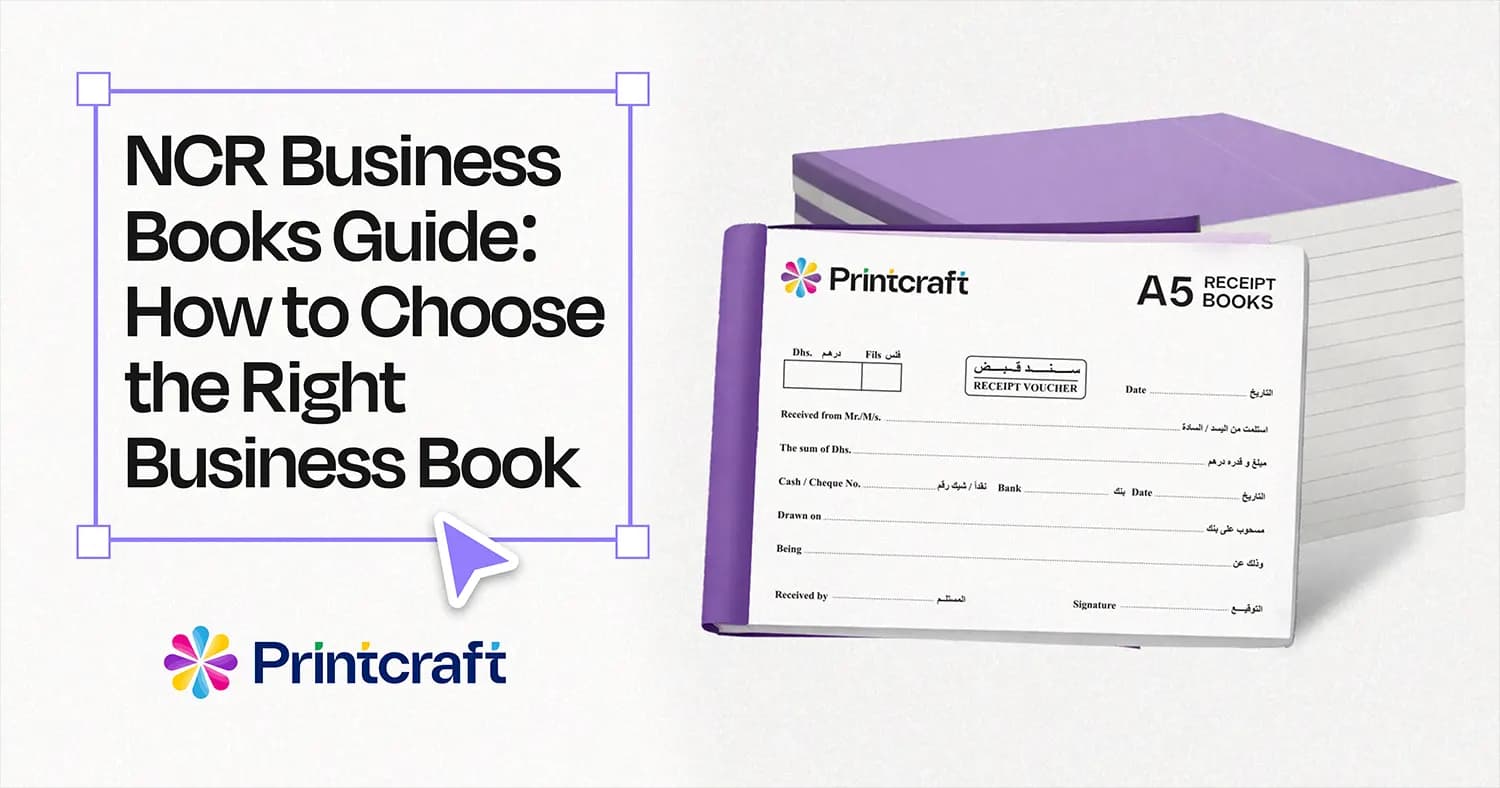
NCR receipt books, payment voucher books, invoice books, and delivery note books offer practical ways to record transactions when a physical document is required. Using carbonless NCR paper, these books allow information written on the first sheet to transfer onto the sheets underneath, creating additional copies without traditional carbon paper.
However, each type of business book serves a different purpose. An invoice records a charge for goods or services, a receipt acknowledges money received, a payment voucher documents an outgoing payment, and a delivery note records the transfer of goods.
Choosing the right format helps employees complete paperwork efficiently, provide the correct copies to customers or departments, and keep physical records organized.
For businesses looking for NCR bill book printing in Dubai, Printcraft.ae offers customizable NCR books in A4, A5, and A6 formats, with options for duplicate, triplicate, and four-part sets, sequential numbering, binding, and branded artwork.
In this guide, we explain the different types of NCR books, when to use each one, how to choose the right number of copies, and which specifications to consider before placing an order.
NCR stands for No Carbon Required. NCR books use specially treated carbonless paper that transfers handwritten information from one sheet to the sheets underneath when pressure is applied.
This allows a business to write a transaction once while producing multiple copies of the same information.
For example, a service technician may complete an invoice, give the original copy to the customer, and retain a duplicate for business records.
A wholesaler may need an additional copy for a delivery driver or warehouse department. A business receiving cash or another form of payment may issue a receipt while keeping a record of the transaction.
The number of copies required determines whether a duplicate, triplicate, or four-part NCR book is appropriate.
You can explore the available formats and customization options in the NCR Bill Books Printing category.
Before choosing the paper size or number of copies, identify the purpose of the document. The correct format depends on what the business needs to record and who needs to receive each copy.
NCR Invoice Book
Purpose: Records charges for goods or services.
Typical use: Retailers, contractors, wholesalers, and service providers.
NCR Receipt Book
Purpose: Acknowledges money received from a customer or another party.
Typical use: Shops, technicians, and service businesses.
Payment Voucher Book
Purpose: Records or supports an outgoing payment.
Typical use: Finance departments and business offices.
Receipt Voucher Book
Purpose: Records money received for accounting or internal documentation.
Typical use: Cashiers and finance teams.
Delivery Note Book
Purpose: Records goods delivered or transferred between parties.
Typical use: Wholesalers, distributors, warehouses, and delivery teams.
Order Book
Purpose: Records orders placed by customers.
Typical use: Sales representatives and trading businesses.
Service Report Book
Purpose: Records work completed or services performed.
Typical use: Maintenance companies and field technicians.
These documents are related, but they are not interchangeable in every situation. For example, a delivery note records the movement of goods, while an invoice records the amount charged. A payment voucher used internally is also different from a receipt issued to a customer.
Selecting the correct format from the beginning makes daily documentation easier to manage.
You can explore available formats and customization options in the NCR Bill Books Printing category.
An NCR invoice book is used to document the goods or services supplied to a customer, including the relevant transaction details and amounts.
It is particularly useful for businesses that prepare handwritten invoices at a counter, on-site, or during a customer visit.
Depending on the business, the invoice layout may include:
A well-organized invoice layout should leave enough space for handwritten information and make important fields easy to locate.
For businesses that need a larger writing area for multiple products or detailed service descriptions, an A4 invoice book may be suitable. Businesses that prefer a compact format for regular transactions can consider A5.
Printcraft.ae offers an A5 Custom NCR Bill Book and an A4 Custom NCR Bill Book, both with customizable artwork and selectable copy configurations.
A receipt book is used to acknowledge that a business has received money from a customer or another party.
Receipts are often issued after a payment is received for a product, service, deposit, outstanding balance, or another transaction.
An NCR receipt book allows the recipient to receive a copy while the business retains another for its records.
A custom receipt layout may include:
The fields should reflect the actual transaction and the business's record-keeping process.
For example, a maintenance company receiving an advance payment may record the amount received, the related job, and any remaining balance. A retail business may need a simpler layout focused on the receipt number, amount, date, and payment details.
For businesses that prefer a dedicated receipt format, Printcraft.ae offers custom A5 receipt book printing. This product uses side binding and can be customized with business details and suitable receipt fields.
A payment voucher book serves a different purpose from a customer receipt book. It is generally used to document, authorize, or support payments made by the business.
For example, a company may use payment vouchers when recording supplier payments, business expenses, staff reimbursements, or other approved outgoing payments.
Depending on the company's accounting workflow, a payment voucher may include:
A numbered voucher book can help the finance team organize physical records and link a payment to its supporting documents.
For example, if a business pays a supplier for delivered goods, the payment voucher can refer to the relevant supplier invoice. The company can then keep the voucher with its other accounting records.
A payment voucher is not automatically proof that a supplier received the money. Businesses should follow their own approval and payment-recording procedures and retain appropriate supporting evidence.
When ordering a custom payment voucher book, plan the layout around the fields your finance team actually uses. This avoids unnecessary information while ensuring the document supports your internal workflow.
The difference is the direction of the transaction.
A receipt voucher generally documents money received by the business. A payment voucher generally documents money paid out by the business.
For example, when a customer pays an outstanding balance, the business may record the receipt. When the business pays a supplier, it may prepare a payment voucher according to its internal process.
Although both documents can be produced as NCR books, their layouts should be designed for their respective purposes.
A receipt voucher may focus on the payer, amount received, date, and reason for payment. A payment voucher may require additional fields for approval, supporting invoices, or payment references.
Before preparing the artwork, consider who will complete the document, who needs to approve it, and which department will retain each copy.
A delivery note book records goods delivered, received, or transferred between parties. It is commonly used by wholesalers, distributors, suppliers, warehouses, and delivery teams.
Unlike an invoice, a delivery note primarily documents the items being moved and the details of the delivery. It does not, by itself, establish that payment has been made.
A custom delivery note may include:
Multiple copies can be useful when the customer, driver, warehouse, or dispatch team needs its own record.
For example, a distributor delivering several items to a retailer may provide one copy to the receiving customer and retain another copy internally. An additional copy may be allocated to the driver or warehouse, depending on the business's workflow.
The appropriate layout and number of copies should reflect how the delivery process operates.
One of the most important decisions when ordering NCR books is the number of copies required for each handwritten entry.
The terms 2-ply, 3-ply and 4-ply describe the number of paper parts in a set.
A duplicate NCR book creates two copies from one written entry.
The set typically consists of:
This format is suitable when two parties need a record, such as a customer and the business issuing an invoice or receipt.
A duplicate format can be a practical choice for small retailers, independent service providers, and businesses with straightforward transaction processes.
A triplicate NCR book creates three copies from one entry.
The set typically consists of:
This format is useful when three parties or departments require copies of the same transaction.
For example, a wholesaler may need copies for the customer, driver, and office. A service company may require copies for the customer, technician, and administration team.
A four-part NCR book creates four copies from a single written entry.
This option can be suitable when several parties or departments require the same document, such as a delivery record or a multi-stage service form.
However, more copies are not always better. Choose the number of plies based on actual record-keeping requirements, since every additional part affects the paper arrangement and overall document specification.
The best choice is the smallest number of copies that allows everyone who needs a record to receive one.
Choosing the correct size helps employees write comfortably and keeps the finished document practical for everyday use.
A4 measures 210 × 297 mm. Its larger writing area makes it suitable for detailed invoices, delivery records, service reports, and forms containing multiple fields.
Consider A4 when your documents need space for several product descriptions, quantities, prices, customer information, or remarks.
Explore A4 Custom NCR Bill Book Printing for a format that can be customized around your business requirements.
A5 measures 148.5 × 210 mm. It provides a balance between writing space and portability.
A5 can be suitable for general invoices, receipts, service records, and other frequently used business documents.
For many businesses, this format provides sufficient space for essential transaction fields without making the book unnecessarily large.
You can review the A5 Custom NCR Bill Book and compare its available options.
A6 measures 105 × 148.5 mm. It is useful when a smaller document is sufficient and portability matters.
Potential applications include compact receipts or simple transaction records with limited information.
Before selecting A6, check that the layout provides enough room for the required fields and legible handwriting. A smaller format may not be suitable for detailed invoices containing many product lines.
You can review the specifications for A6 Custom NCR Bill Book Printing and confirm current availability and options before ordering.
Sequential numbering assigns document numbers in an ordered series. It helps businesses track documents and identify where records belong in their transaction history.
For example, a receipt book may use a sequence such as 0001, 0002, 0003 and so on.
Numbering can help a business:
For businesses using several books, plan the numbering series carefully. Separate document types or departments may require separate sequences, depending on the company's procedures.
Also, check that the printed numbers follow the intended order and that the numbering arrangement is suitable for the way each document is issued.
Sequential numbering supports document control, but it does not replace proper accounting records or internal checks.
The binding style affects how employees write on, store, and remove documents from an NCR book.
Top binding is commonly used for invoice books and other forms that are completed and removed from the top of the book.
It provides a familiar format for businesses that issue invoices or delivery notes during regular transactions.
Side binding can be useful for receipt-style formats or documents designed to be handled horizontally.
The appropriate orientation depends on how the employee writes on the page and how the book is held during a transaction.
Perforation creates a line of small cuts that makes a sheet easier to tear out neatly.
It is useful when one copy must be handed to a customer while the retained copy remains in the book or attached set.
When preparing your order, confirm which sheets need to be removable and how the copies should remain organized after removal.
A well-designed NCR book should be easy to complete, easy to read, and suitable for the way the business operates.
Place frequently used fields, such as the date, document number, customer name, and total amount, where employees can find them quickly.
Avoid filling the page with unnecessary decorative elements that reduce the available writing area.
Consider the amount of information staff usually enter manually.
For an invoice, this may include multiple product lines, quantities, unit prices, and totals. For a receipt, the layout may require only the payment details and a short description.
Choose a size that accommodates the information without making the text or writing fields too small.
Depending on the purpose of the book, include the company name, logo, address, telephone number, and other relevant details.
You can also include designated fields for transaction numbers, signatures, reference numbers, or internal approval.
Businesses operating in the UAE may serve customers and employees who use different languages.
A bilingual Arabic and English layout can make a document easier to understand when both languages are required. Confirm the wording, direction of text, alignment, and available writing space before approving the artwork.
Check the spelling, contact details, numbering requirements, field labels, and alignment before production.
If the book is used for important business records, ask for an artwork proof or sample where available. Review how the page reads, how much space is available for handwriting, and whether the intended information can be recorded clearly.
Businesses in the UAE should distinguish between customizing a printed invoice layout and meeting the invoicing requirements applicable to a particular transaction.
The UAE Federal Tax Authority's guidance on tax invoices identifies information such as the words "Tax Invoice", a sequential or otherwise uniquely identifying invoice number, the issue date, supplier details and TRN, relevant recipient details, a description of the goods or services, applicable VAT information, and the amount payable. The exact requirements depend on the type of invoice and applicable rules.
An NCR book can be designed with fields for the business information your organization needs to record. However, adding a TRN field or printing the words "Tax Invoice" does not, by itself, establish that a document meets every applicable legal requirement.
Businesses should review the official Federal Tax Authority tax invoice guidance and obtain professional advice where necessary.
The UAE is introducing an electronic invoicing system in phases. The Ministry of Finance defines an eInvoice as structured invoice data that is issued and exchanged electronically through the relevant system. A PDF, scanned document, image, or email is not, on its own, an eInvoice under that definition.
For businesses that fall within the mandatory electronic invoicing rules, a printed NCR invoice book should not be assumed to replace the applicable e-invoicing requirements. Physical books may still have an appropriate operational or record-keeping role, depending on the business and transaction, but their use needs to be considered alongside the rules applicable to that business.
Check the latest information on the official UAE Ministry of Finance eInvoicing portal before deciding how your invoicing process should operate.
Before placing an order, review the document's purpose, format, number of copies, and finishing requirements.
Use this simple checklist to prepare your specifications.
1. Decide the document type.
Choose an invoice book, receipt book, payment voucher, receipt voucher, delivery note, or another business form based on the transaction being recorded.
2. Choose the size.
Consider A4 for detailed forms, A5 for general business transactions, or A6 for compact records.
3. Determine the number of copies.
Select 2-ply, 3-ply, or 4-ply according to how many people or departments require a copy.
4. Confirm the binding.
Choose top or side binding according to the document's layout and intended use.
5. Decide whether numbering is required.
Specify the starting number and the intended sequence if you need sequential numbering.
6. Confirm perforation requirements.
Identify which sheets need to be removed and which copies must remain attached or retained.
7. Prepare your artwork.
Provide your logo, business details, field labels, and other required information. Confirm any bilingual layout, colour, or design requirements.
8. Check the proof and order details.
Review the layout, quantity, specifications, selected options, and final production information before approving the order.
For available sizes and customization options, start with Printcraft's NCR Bill Books Printing category.
At Printcraft.ae, we provide customized printing solutions in Dubai for businesses that need professional printed materials designed around their daily requirements.
Our NCR product range includes A4, A5, and A6 custom bill books and A5 receipt books. Available options include different copy configurations, selectable printing colours, sequential numbering, and customization using your artwork.
Whether you need invoice books for customer transactions, receipt books for payments received, or business forms for regular documentation, selecting the right format helps create a more practical and organized workflow.
You can explore our NCR Bill Books Printing category to review available products and options.
If you already have artwork, prepare your print-ready file and confirm the product specifications before ordering. If you need help planning the layout, contact our team to discuss the details of your project and the available customization options.
NCR invoice books, receipt books, payment vouchers, and delivery notes serve different purposes in everyday business operations. Choosing the right document format helps employees record transactions clearly and provide the necessary copies to customers, finance teams, warehouse staff, or other departments.
Duplicate NCR books are useful when two copies are sufficient, triplicate books serve situations requiring three copies, and four-part books can support workflows that require an additional record.
The right size, binding, perforation, numbering, and layout depend on how your business uses each document. Businesses should also ensure that their printed forms support their actual record-keeping needs and are not mistaken for a substitute for any applicable electronic invoicing obligations.
For businesses looking for customized NCR books in Dubai, Printcraft.ae offers a range of invoice and receipt book options that can be tailored to your branding and document requirements.
Need custom NCR invoice books, receipt books, or other carbonless business forms? Explore the NCR Bill Books Printing category and select a format suited to your business.
Get a Quote Today and prepare printed business forms that support your everyday transactions.
1. What is an NCR receipt book?
An NCR receipt book uses carbonless paper to create additional copies of a handwritten receipt. It allows a business to provide a copy to the customer while retaining another copy for its records.
2. What is the difference between an invoice book and a receipt book?
An invoice book records charges for goods or services. A receipt book acknowledges money received. Although both can use NCR paper, their layouts and purposes differ.
3. What is a payment voucher book used for?
A payment voucher book is generally used to document or support payments made by a business, such as supplier payments or business expenses. It may include payment details, supporting references, and approval fields.
4. What is the difference between a receipt voucher and a payment voucher?
A receipt voucher generally records money received by a business, while a payment voucher generally documents money paid out. The exact fields depend on the company's accounting procedures.
5. What does duplicate or 2-ply mean in NCR printing?
A 2-ply NCR set contains two paper parts: the original and one duplicate. It is suitable when two copies of a handwritten transaction are required.
6. What is the difference between triplicate and four-part NCR books?
A triplicate or 3-ply set produces three copies, while a four-part or 4-ply set produces four. The appropriate option depends on the number of parties or departments that need a copy.
7. Which size is best for NCR invoice books?
A4 can be suitable for detailed invoices and forms with many fields. A5 provides a balance between writing space and portability, while A6 can suit compact documents with limited information.
8. Can I add my company logo and VAT/TRN details to an NCR book?
Custom artwork can include a company logo, business information, and relevant VAT/TRN fields. The layout should be checked against the applicable invoicing requirements. Printing these details does not automatically guarantee tax compliance.
9. Can NCR books have sequential numbering and perforated pages?
These features may be available depending on the selected product and specifications. Sequential numbering helps identify documents, while perforation makes selected sheets easier to remove neatly.
10. Where can I order custom NCR bill and receipt books in Dubai?
You can explore the NCR Bill Books Printing category on Printcraft.ae to review available A4, A5, A6, and receipt book options. Confirm the current product specifications, quantity, artwork requirements, and production options before placing your order.
At Printcraft.ae, we help businesses in Dubai and across the UAE explore customized printing solutions for everyday operations. From NCR invoice books and receipt books to other branded business materials, our product range provides options for different document requirements.
Whether you need duplicate invoices, triplicate receipt books, or customized business forms, review the available options and choose a layout that suits your workflow.
Explore NCR Bill Books Printing and Get a Quote Today.