
Loading...
Loading...
Tooba Asad • 16 Sep 2026
Learn the key differences between digital printing and offset printing, including cost, quality, turnaround time, personalization, and ideal print quantities. Discover which printing method is better suited for business cards, brochures, packaging, and other business printing needs.
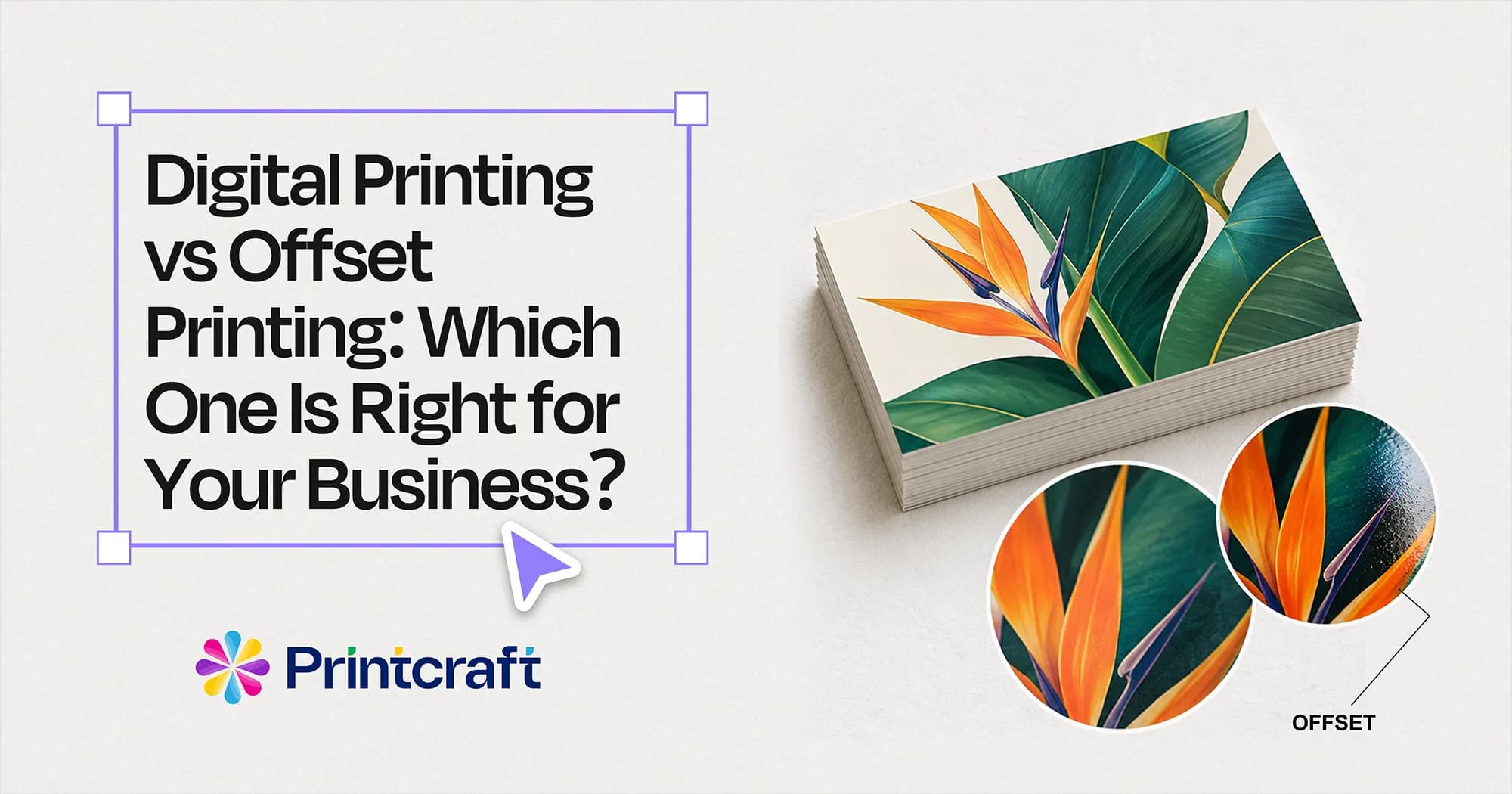
Choosing the right printing method can have a major impact on the quality, cost, turnaround time, and overall appearance of your printed materials. Two of the most widely used options are digital printing and offset printing.
While both methods can produce professional results, they are designed for different printing requirements. Digital printing is often suitable for smaller quantities and quick projects, while offset printing can be a practical choice for larger print runs where consistency and customization are important.
Understanding how these two methods differ can help you select the right solution for your business.
Digital printing is a modern printing method where digital files are sent directly to a digital printer. Unlike traditional offset printing, it does not require printing plates.
This makes digital printing particularly useful when you need a smaller quantity of printed materials or a quick turnaround. It also makes it easier to make changes between print runs.
Businesses commonly use digital printing for business cards, flyers, brochures, posters, invitations, menus, labels, and other marketing materials.
Digital printing offers several advantages for businesses:
For businesses that need a relatively small quantity or require printed materials quickly, digital printing can be a convenient option.
Offset printing is a traditional commercial printing process that uses plates to transfer an image onto a rubber blanket before applying it to the printing surface.
The process involves more preparation than digital printing, but it can be highly efficient for larger quantities. Once the press is set up, producing a large number of identical printed pieces becomes more economical.
Offset printing is commonly used for brochures, catalogs, magazines, stationery, packaging, business cards, and large marketing campaigns.
Offset printing can offer several advantages, particularly for larger projects:
For businesses ordering a large volume of the same printed material, offset printing can be an effective solution.
The biggest difference between the two methods is how the design is transferred to the printed material.
Digital printing transfers the digital design directly to the printing surface, while offset printing uses plates and a multi-step transfer process.
Here are some key differences:
Feature
Setup
Best for
Turnaround
Personalization
Large-volume cost
Color consistency
Design changes
Digital Printing
Minimal setup
Small to medium quantities
Generally faster for short runs
Easy
Can be higher per piece
High
Easy between batches
Offset Printing
Requires plate preparation
Large print quantities
More preparation time
More limited
Often more economical
Excellent consistency
Less convenient once plates are prepared
The right option depends on the size, purpose, budget, and timeline of your project.
Cost depends on several factors, including quantity, paper, ink or toner requirements, finishing, size, and design complexity.
For smaller quantities, digital printing can often be more practical because it requires less setup. You can print only the quantity you need without preparing printing plates.
For larger print runs, offset printing may become more cost-effective because the initial setup cost is spread across a greater number of printed pieces.
Instead of looking only at the price per piece, consider the total project cost and the quantity you actually need.
Both digital and offset printing can produce high-quality professional results.
Offset printing has traditionally been preferred for projects requiring highly consistent color reproduction across a large quantity. It can also provide access to various inks and specialty printing options.
Digital printing has also developed significantly and can produce sharp text, detailed graphics, and vibrant images suitable for many business applications.
For most everyday business printing projects, the difference may depend more on the specific printer, paper, finishing, and design than simply the printing method.
Both methods can be used for professional business cards.
Digital printing can be a convenient option when you need a smaller batch or want to print cards with different names, contact details, or other personalized information.
Offset printing can be suitable when you need a larger quantity of identical business cards and want consistent results throughout the entire batch.
Your choice should depend on how many cards you need and whether personalization is important.
For brochures, both methods have their advantages.
Digital printing can work well for smaller marketing campaigns, test batches, or brochures that may need frequent updates.
Offset printing can be useful when you're producing a large quantity of brochures for a major campaign, event, product launch, or long-term marketing activity.
If you're unsure about the right option, your printer can assess the quantity and design requirements before production.
Packaging projects can involve more than simply choosing a printing process. Material, coating, finishing, colors, design complexity, and production quantity can all affect the final result.
Digital printing can be useful for short packaging runs, customized packaging, or projects where different designs are required.
Offset printing may be more suitable for high-volume packaging production where consistent branding across a large quantity is important.
Digital printing may be the right choice when:
For example, a small business launching a new service may choose digital printing to produce a limited number of promotional brochures before committing to a larger print run.
Offset printing may be worth considering when:
It can be particularly useful for businesses that regularly order large quantities of branded materials.
Yes. Businesses don't necessarily have to rely on one printing method for every project.
For example, you could use offset printing for a large quantity of standard brochures while using digital printing for smaller batches of personalized promotional materials.
Using the right method for each project can help you manage printing costs, quantities, timelines, and marketing requirements more effectively.
Before deciding between digital and offset printing, consider these five factors:
1. Quantity
Determine how many copies you actually need. Your required quantity can significantly influence which method makes sense.
2. Deadline
If you need printed materials quickly, the turnaround requirements should be part of your decision.
3. Budget
Compare the overall project cost rather than focusing only on the price of individual copies.
4. Personalization
If every copy needs different information, digital printing may provide greater flexibility.
5. Quality and finishing
Consider the paper, colors, coating, and finishing options required for your final product.
There isn't one printing method that works for every business or every project. Digital printing and offset printing each have their own advantages, and the right choice depends on your quantity, budget, timeline, design, and finishing requirements.
At Printcraft, businesses can explore professional printing solutions for marketing materials, business stationery, packaging, promotional products, and more. Choosing the appropriate printing method can help you achieve the quality and finish you want while keeping your project requirements in mind.
Planning your next printing project? Contact Printcraft to discuss your requirements and find a suitable printing solution for your business.
Digital printing transfers a digital file directly to the printing surface, while offset printing uses plates and a transfer process. This makes digital printing convenient for shorter runs and offset printing suitable for many larger-volume projects.
It depends on the quantity and project requirements. Digital printing can be more practical for smaller quantities, while offset printing can become more economical for larger print runs.
Digital printing generally requires less setup, which can make it suitable for projects with shorter turnaround requirements. Offset printing involves additional preparation before production begins.
Both can produce high-quality results. Offset printing is known for consistent reproduction across large quantities, while modern digital printing can also provide excellent detail and color quality.
Both methods can work well. Digital printing can be useful for smaller quantities or personalized cards, while offset printing can be suitable for larger quantities of identical business cards.
Digital printing can handle larger quantities, but the most suitable method depends on the specific project. For very large print runs, offset printing may offer production and cost advantages.
Yes. One of the key advantages of digital printing is the ability to personalize individual printed pieces without creating new printing plates.
Consider your required quantity, deadline, budget, design, personalization needs, paper, and finishing requirements. A professional printing company can also help you evaluate these factors before production.
At printcraft.ae online printing service, we help businesses choose the right printing method for their quantity, budget, timeline, and print requirements. From business cards and flyers to brochures, menus, packaging, and marketing materials, get professional printing tailored to your needs.
Get a Quote / Browse Printing Products / hello@printcraft.ae / +971556265479