
Loading...
Loading...
Tooba Asad • 28 Oct 2026
Stickers are a versatile way for businesses to promote their brands, personalize products, and improve packaging. From product labels and promotional giveaways to laptop decals and custom merchandise, the right sticker can help a business stand out. However, choosing between die-cut stickers and regular stickers can be confusing when both options serve different purposes.
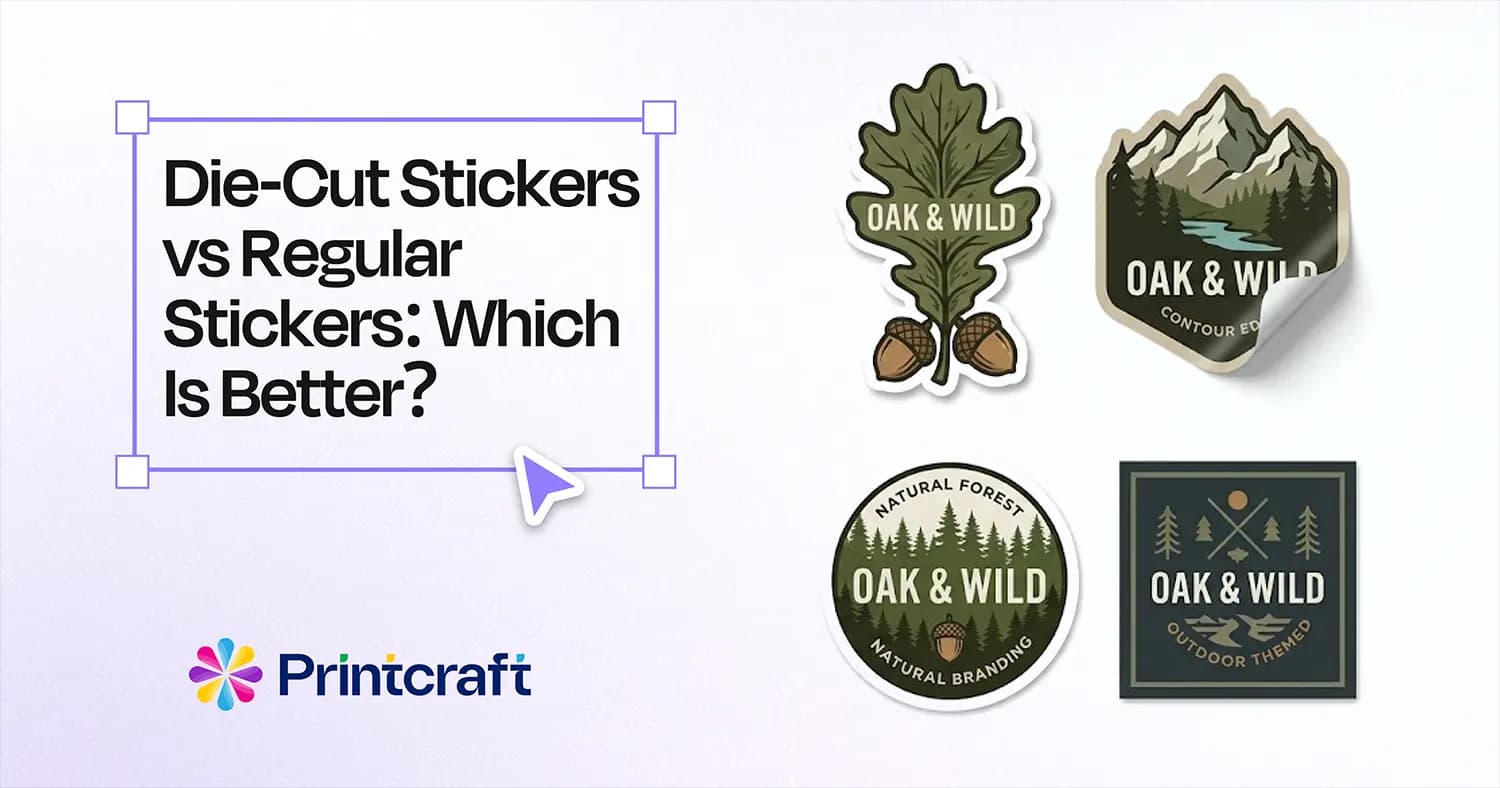
Die-cut stickers are cut into custom shapes that follow the outline of a design, while regular stickers are commonly supplied in standard shapes such as circles, squares, and rectangles. Each option offers distinct advantages in terms of appearance, practicality, and cost.
Understanding the differences between die-cut stickers and regular stickers can help you select the best option for your branding, packaging, and marketing needs.
Die-cut stickers are custom-shaped stickers cut precisely around the outline of a design. Unlike stickers with standard geometric borders, they follow the contours of logos, illustrations, lettering, characters, or other artwork.
For example, a business with a uniquely shaped logo can turn it into a die-cut sticker that follows the logo's exact outline rather than placing it inside a square or circular border.
Die-cut stickers are often made from materials such as vinyl or paper, depending on their intended application. They can be used for indoor branding, outdoor promotions, product decoration, packaging, and giveaways.
Die-cut stickers are particularly useful when a business wants its sticker design to become an identifiable part of its brand presentation.
Regular stickers are stickers produced in conventional shapes, including circles, squares, rectangles, and ovals. They may feature printed logos, product information, promotional messages, or decorative designs.
These stickers are widely used because standard shapes are practical for labeling, organizing, packaging, and everyday promotional activities.
Regular stickers can be produced from paper, vinyl, and other suitable materials. Their durability depends on the material, adhesive, and finish selected.
For businesses that prioritize functionality, consistency, and straightforward production, regular stickers are often a practical choice.
Die-cut stickers offer several advantages for businesses that want to create distinctive visual branding.
Because die-cut stickers follow the outline of the artwork, they can create a more customized appearance. A logo, character, or illustration can retain its original shape instead of being surrounded by an additional geometric border.
This can make promotional materials more visually appealing and help a design stand out.
A distinctive sticker shape can become part of a business's visual identity. Companies can use custom-shaped logo stickers on packaging, promotional items, laptops, notebooks, and other suitable surfaces.
Consistent use of recognizable designs can help customers associate the sticker with the brand.
Die-cut stickers are popular for events, product launches, exhibitions, and promotional campaigns. Their custom appearance makes them suitable for giveaways that customers may want to keep and use.
Businesses can create stickers featuring mascots, slogans, illustrations, or branded graphics to support marketing activities.
Brands, artists, creators, and small businesses can use die-cut stickers as part of their merchandise collections. Custom shapes allow designs to reflect a particular style or theme.
They can also complement products such as notebooks, gift packaging, and promotional merchandise.
Die-cut stickers can accommodate a wide variety of artwork, from simple logos to detailed illustrations. The final result depends on the design, cutting limitations, material, and production method.
For the best outcome, artwork should have a clear outline and sufficient spacing around small or intricate details.
Regular stickers remain a popular option because they offer practicality and versatility across many business applications.
Standard-shaped stickers are useful for displaying product names, ingredients, instructions, pricing, and other relevant information. Rectangular labels, for example, provide a structured area for text and branding.
This makes regular stickers particularly useful for products that require readable information.
Businesses can use regular stickers to seal packaging, display logos, identify products, or add promotional messages to boxes and bags.
Their predictable shapes make it easier to maintain consistent placement across different packages.
When businesses require large numbers of identical labels, standard shapes can simplify layout and production planning. Depending on the printing method and specifications, they may also help control costs.
However, actual pricing depends on the order quantity, dimensions, material, finish, and production process.
Regular stickers are useful when information needs to fit within a defined space. Their conventional shapes can create an organized appearance that works well for retail products, shipping labels, and inventory identification.
From packaging and office supplies to promotional campaigns and retail labeling, regular stickers can support numerous everyday business needs.
Their simplicity makes them an adaptable choice for businesses with varied labeling requirements.
Die-cut stickers are the better option when the shape of your artwork is an important part of the design or branding strategy.
Consider die-cut stickers when:
For example, a clothing brand may use die-cut logo stickers on shopping bags, while a coffee shop may create custom-shaped stickers for takeaway cups or promotional gifts.
Regular stickers are generally a better choice when practicality, readability, and consistent labeling are the main priorities.
Choose regular stickers when:
For instance, a skincare business might use rectangular stickers for ingredient information and circular stickers for simple brand seals. A shipping company may prefer rectangular labels because they provide a practical layout for addresses and tracking information.
The cost of die-cut stickers versus regular stickers depends on several production factors.
Regular stickers in standard shapes may be more economical because their cutting requirements are straightforward. Die-cut stickers can involve more customized cutting, particularly when designs contain complex outlines or intricate details.
However, the price difference is not always significant. Large order quantities, material selection, sticker dimensions, printing requirements, and finishing options can all influence the final cost.
Before placing an order, consider the following:
The most cost-effective choice is the one that meets your business requirements without adding unnecessary features.
Both die-cut and regular stickers can improve product packaging, but their suitability depends on how the sticker will be used.
Die-cut stickers work well for decorative packaging, custom logos, brand mascots, and promotional designs. They can give packaging a distinctive appearance and help reinforce brand identity.
Regular stickers are often more practical for product information, standard brand seals, pricing, and labels that need a consistent shape across different products.
Businesses can also combine both options. For example, a company may use rectangular product information labels alongside die-cut logo stickers to create packaging that is both informative and visually appealing.
When packaging will encounter water, humidity, or frequent handling, material selection is equally important. Waterproof vinyl or another suitable moisture-resistant material may be preferable to standard paper, regardless of the sticker's shape.
Before ordering custom stickers, evaluate your business goals and practical requirements.
Decide whether the stickers will be used for branding, product information, packaging, decoration, or giveaways. This helps determine whether a custom outline or standard shape will be more suitable.
Review your logo, artwork, and text. If the outline is distinctive, die-cut stickers may showcase it more effectively. If your design contains extensive product information, a standard rectangular shape may be easier to organize.
Choose a material that suits the application. Paper stickers can work well for many dry indoor uses, while vinyl is commonly selected for applications requiring greater flexibility and moisture resistance.
Consider whether the stickers will be applied to cardboard, glass, plastic, metal, or another surface. Adhesive compatibility can affect how well the sticker stays in place.
Request pricing based on your actual dimensions, quantity, material, and finish. Reviewing a sample can help you assess color accuracy, cutting quality, adhesive performance, and overall appearance before ordering a large batch.
Choosing between die-cut stickers and regular stickers comes down to your design goals and business needs. Die-cut stickers are ideal for custom branding, promotional giveaways, and distinctive artwork, while regular stickers are practical for product labels, packaging, and applications that require a consistent shape.
Both options can support effective branding when the material, design, and finish are selected carefully. You can also combine them to balance visual appeal with everyday functionality.
If you are looking for custom sticker printing for your business, Printcraft can help you explore suitable sticker options for product packaging, promotional campaigns, and brand identity. Choose a format that reflects your design while meeting your practical requirements.
1. What is the main difference between die-cut stickers and regular stickers?
Die-cut stickers are cut to follow the outline of a design, while regular stickers typically use standard shapes such as circles, squares, and rectangles. Die-cut stickers emphasize custom appearance, whereas regular stickers are often chosen for practical labeling.
2. Are die-cut stickers more expensive than regular stickers?
They can be, especially when the design requires complex cutting. However, the final cost depends on quantity, size, material, finish, and production requirements.
3. Are die-cut stickers better for branding?
Die-cut stickers can be particularly effective for branding because their custom shapes help showcase logos, illustrations, and distinctive artwork. Regular stickers can also support strong branding through consistent design and placement.
4. Can regular stickers be used for product packaging?
Yes. Regular stickers are widely used for packaging seals, product information, logos, pricing, and promotional messages. They are particularly useful when businesses need consistent shapes and readable text.
5. Are die-cut stickers waterproof?
Not automatically. Their water resistance depends on the material, ink, adhesive, and protective finish. Vinyl stickers with suitable printing and lamination can be a good choice for applications exposed to moisture.
6. Which sticker type is better for small businesses?
Both options can work well for small businesses. Die-cut stickers are useful for promotional branding and merchandise, while regular stickers are practical for packaging labels and product information. The right choice depends on budget and intended use.
7. Can I print my company logo on die-cut stickers?
Yes. Company logos can be printed as die-cut stickers and cut around their outlines. The final shape depends on the artwork and production requirements.
8. Are die-cut stickers suitable for outdoor use?
They can be suitable for outdoor use when made from weather-resistant materials with appropriate adhesive and printing. For prolonged outdoor exposure, consider UV resistance and protective lamination.
9. Can I use both die-cut and regular stickers for my products?
Yes. Businesses can use regular stickers for product details and die-cut stickers for logos or decorative elements. Combining the two can create packaging that is both practical and visually appealing.
10. Where can I order custom stickers in Dubai?
Businesses can contact Printcraft to discuss custom sticker printing for product labels, packaging, merchandise, and promotional campaigns. Share your design, preferred dimensions, quantity, and intended application to determine the most suitable option.
At printcraft.ae, we offer Die-cut stickers printing and regular stickers in Dubai. Choose your preferred material, size, shape, and finish to create professional stickers for your products and brand.